
From the Field
Lessons from the Field
From the Field is where we share what we’re seeing across different types of land throughout the Midwest. Our updates include regular reports on what land is selling for, along with practical insights to help landowners, buyers, and investors make informed decisions.
Why Landowners Across North Dakota, South Dakota & Minnesota Trust Nikolaisen Land Company as Their Go-To Resource
When it comes to owning land, the questions never stop.
What is my land worth?
Who owns this property?
Should I sell now or wait?
How does an online land auction work?
What happens to farmland after someone passes away?
How do I settle an estate or divide inherited land fairly?
These are important questions that deserve accurate, trustworthy answers. At Nikolaisen Land Company, we believe every landowner should have access to reliable information—whether they’re preparing to sell, settling an estate, researching land values, or simply learning more about the property they own.
For more than 30 years, we’ve been privileged to help landowners throughout North Dakota, South Dakota, and Minnesota make informed decisions about one of their most valuable assets—their land. With more than $100 million in land and real estate transactions, we’ve built our reputation on knowledge, integrity, and results.
More Than a Land Company
Land ownership involves far more than buying and selling.
It often includes family history, estate planning, taxes, conservation programs, leases, mineral rights, boundary questions, farming operations, and long-term investments. Because every property—and every family—is different, having a knowledgeable resource can make all the difference.
That’s why our goal extends beyond conducting successful land auctions. We strive to become the most trusted online source for information about:
- Land ownership
- Farmland values
- Online land auctions
- Estate and probate land issues
- Agricultural real estate trends
- Land management
- Buying and selling rural property
Whether you’re a first-generation landowner or your family has farmed the same ground for over a century, we’re committed to providing information that helps you make confident decisions.
Local Knowledge Matters
National websites can provide general information, but land is local.
A quarter of land in Towner County may have a very different market than one in Codington County or Polk County. Soil productivity, drainage, access, hunting potential, local demand, conservation easements, rental rates, and regional buyer activity all influence value.
Because our team works throughout North Dakota, South Dakota, and Minnesota every day, our guidance is rooted in real market activity—not generic averages or automated estimates. Our land valuations are based on current market data, regional expertise, and an understanding of the unique characteristics of each property.
A Resource for Families, Attorneys & Professionals
Many of the questions we receive don’t begin with a planned sale.
Instead, they’re often related to life’s major transitions:
- Settling an estate
- Dividing inherited farmland
- Determining a property’s value
- Understanding current market conditions
- Planning for future generations
- Evaluating whether an auction or traditional listing is the better choice
These situations require thoughtful guidance, clear communication, and dependable information. Our goal is to help families and the professionals who serve them navigate these decisions with confidence.
Education First
Knowledge empowers better decisions.
That’s why we’re continually adding educational articles, market updates, land valuation insights, auction information, and practical resources to help landowners stay informed.
Whether you’re researching land values, preparing for an auction, exploring estate-related questions, or simply curious about today’s agricultural real estate market, we invite you to use our website as a trusted source of information.
Built on Trust. Focused on the Future.
Trust isn’t earned through advertising.
It’s earned through honest conversations, accurate information, and consistently doing what’s right for the people we serve.
At Nikolaisen Land Company, we’re proud to help landowners across North Dakota, South Dakota, and Minnesota understand their land, protect their legacy, and make informed decisions for generations to come.
If you have questions about land ownership, land values, online auctions, estate-related land matters, or simply want to better understand your property’s potential, we’re here to help.
Because great decisions begin with trusted information.
Nikolaisen Land Company
Experience. Integrity. Results.
How Is Land Actually Valued? The Factors That Determine What Your Property Is Worth
Whether you’re considering selling, planning your estate, gifting land to family, settling an estate, or simply curious about today’s market, one of the most common questions we hear is:
“How much is my land worth?”
The answer is more involved than simply looking at the number of acres or comparing a nearby sale. Every property is unique, and determining its value requires careful analysis of many different factors.
At Nikolaisen Land Company, our goal is to provide landowners with a well-researched, market-supported valuation that reflects what today’s buyers are truly willing to pay.
- Location Matters
As with nearly every type of real estate, location plays a significant role in value.
Land located near expanding communities, along major highways, or in highly productive farming regions often commands stronger demand. Even properties only a few miles apart can have noticeably different values based on access, surrounding land use, and local market activity.
- Soil Productivity
For agricultural land, soil quality is one of the most important value drivers.
Buyers carefully evaluate:
- Soil productivity indexes
- Crop history
- Drainage characteristics
- Organic matter
- Overall farming capability
Higher-producing soils generally support greater long-term earning potential, making them more attractive to buyers.
- Cropland, Pasture, or Recreational Land
Not all acres are created equal.
The mix of cropland, pasture, hay ground, wetlands, timber, or recreational acreage significantly affects value. Productive cropland is often valued differently than pasture, while hunting and recreational properties may command premium prices depending on wildlife habitat, location, and accessibility.
Understanding how each acre contributes to the property’s overall appeal is an essential part of a comprehensive valuation.
- Access
Good access adds value.
Properties with well-maintained roads, legal access, and convenient entry points are generally more attractive to buyers than parcels with limited or difficult access.
Access also influences future farming efficiency, development potential, and recreational use.
- Comparable Sales
One of the strongest indicators of value is what similar properties have recently sold for.
However, simply knowing a sale price is only part of the picture.
Professional valuation involves analyzing comparable properties based on:
- Location
- Soil quality
- Size
- Improvements
- Topography
- Access
- Market timing
- Buyer demand
Each comparable sale is carefully adjusted to reflect the unique characteristics of the property being evaluated.
- Improvements
Buildings, grain bins, livestock facilities, fences, water systems, and other improvements may contribute additional value.
The condition, usefulness, age, and market demand for these improvements all influence how buyers view the property.
- Easements and Restrictions
Certain easements or restrictions can affect market value.
These may include:
- U.S. Fish & Wildlife easements
- Conservation easements
- Wetland restrictions
- Utility easements
- Pipeline easements
- Wind or solar agreements
While these do not automatically reduce value, they can influence how the property may be used and marketed.
- Current Market Conditions
Land values are constantly changing.
Interest rates, commodity prices, cash rental rates, investor demand, available inventory, and buyer confidence all influence today’s market.
A valuation prepared several years ago may no longer accurately reflect current market conditions.
- The Human Element
Perhaps the most overlooked factor is buyer motivation.
Some buyers are expanding a family operation.
Others are investors seeking long-term appreciation.
Some are neighboring landowners willing to pay a premium to acquire land adjoining their existing operation.
Understanding today’s buyers is just as important as understanding the land itself.
No Two Properties Are Exactly Alike
Even neighboring quarter sections can have significantly different values based on soils, access, improvements, topography, water features, hunting opportunities, or market demand.
That’s why professional land valuation involves much more than multiplying acres by a price-per-acre estimate.
Every property deserves an individualized evaluation supported by current market data and local expertise.
Experience Matters
At Nikolaisen Land Company, we combine decades of experience with extensive market research, comparable sales analysis, aerial imagery, mapping technology, and local knowledge to provide landowners with comprehensive land valuations they can rely on.
Whether you’re planning a sale, settling an estate, making family decisions, or simply curious about today’s market, we’re here to help you understand the true value of your property.
If you’d like to learn more about your property’s current market value, we’d be honored to visit with you. Contact Nikolaisen Land Company to schedule a confidential land valuation and consultation.

Happy 250th Birthday America!
250 Years of Freedom, Pride, and Opportunity
As America approaches its 250th birthday, we’re reminded of the values that built this nation—hard work, independence, and the freedom to pursue our dreams.
There’s a special kind of pride that comes with being an American. It’s found in our communities, our traditions, and in the belief that with determination and perseverance, anything is possible.
That same spirit is reflected in the pride of land ownership. Whether it’s a family farm, a ranch, a hunting property, or a place to build a future, owning a piece of this great country represents more than just acreage—it represents freedom, stewardship, and a lasting legacy for generations to come.
For 250 years, Americans have worked the land, cared for it, and passed it down as a symbol of opportunity and independence. As we celebrate this historic milestone, we honor those who came before us and look forward to the future we’re building together.
Here’s to 250 years of freedom, faith, hard work, and the enduring American dream!
Happy 250th Birthday, America!! Land of opportunity. Home of liberty. And a place we’re proud to call home.
What Taxes Will You Pay When Selling Recently Inherited Land?
Inheriting land can be both a blessing and a challenge. Many beneficiaries choose to sell inherited property rather than maintain it, but a common question arises: What taxes will I owe if I sell land that I recently inherited?
The answer depends on several factors, including the land’s value at the time of inheritance, the selling price, and whether any state taxes apply. Understanding the tax rules can help you avoid surprises and plan for potential tax liabilities.
Step 1: Understand the “Stepped-Up Basis”
One of the most important tax benefits available to heirs is the stepped-up basis.
When you inherit land, your tax basis is generally adjusted to the property’s fair market value on the date of the deceased owner’s death. This means you do not inherit the original owner’s purchase price for tax purposes.
Example
Suppose your parent purchased a parcel of land for $20,000 many years ago. At the time of their death, the land was worth $150,000.
Your tax basis would generally become $150,000 rather than $20,000.
If you sell the land shortly after inheriting it for $155,000, your taxable gain would typically be only $5,000.
Step 2: Calculate Your Capital Gain or Loss
When inherited land is sold, the primary federal tax consideration is usually a capital gain or capital loss.
The calculation is:
Sale Price
Minus
Selling Expenses
Minus
Tax Basis (Stepped-Up Value)
The result is your capital gain or loss.
Example
- Sale price: $200,000
- Closing costs and commissions: $10,000
- Stepped-up basis: $180,000
Taxable gain:
$200,000 − $10,000 − $180,000 = $10,000
In this scenario, you would report a $10,000 capital gain.
Step 3: Long-Term Capital Gain Treatment
A unique tax rule applies to inherited property.
Regardless of how long you personally own the inherited land before selling it, the IRS generally treats the sale as a long-term capital gain or loss.
This can be advantageous because long-term capital gains are typically taxed at more favorable rates than ordinary income.
For many taxpayers, federal long-term capital gains rates are:
- 0%
- 15%
- 20%
The applicable rate depends on your total taxable income.
Step 4: Consider State Income Taxes
In addition to federal taxes, many states impose income tax on capital gains.
The amount varies significantly by state. Some states have no income tax, while others tax capital gains at the same rate as ordinary income.
Before selling inherited land, it is important to understand your state’s tax rules or consult a qualified tax professional.
Step 5: Be Aware of Estate and Inheritance Taxes
Many heirs worry about estate taxes or inheritance taxes when selling inherited property.
In most cases:
Federal Estate Tax
Federal estate tax is generally paid by the estate, not the beneficiary. Only very large estates are subject to federal estate tax.
State Inheritance Taxes
A few states impose inheritance taxes on beneficiaries. Whether one applies depends on the state and your relationship to the deceased.
These taxes are separate from the capital gains tax resulting from the sale of the land.
What If the Land Increased in Value After Inheritance?
If the land appreciates after you inherit it, the increase in value may be taxable when sold.
Example
- Value at inheritance: $300,000
- Sale price one year later: $350,000
Potential taxable gain:
$350,000 − $300,000 = $50,000
Any additional selling expenses would reduce the gain.
What If the Land Sells for Less Than Its Inherited Value?
If the land is sold for less than its stepped-up basis, you may have a capital loss.
Example
- Inherited value: $250,000
- Sale price: $220,000
Potential capital loss:
$30,000
Depending on your circumstances, capital losses may be used to offset capital gains and potentially reduce taxable income.
Recordkeeping Is Critical
Before selling inherited land, keep copies of:
- Appraisals
- Estate documents
- Probate records
- Closing statements
- Surveys and title records
- Receipts for improvements made after inheritance
These documents help establish your basis and support the tax treatment reported on your tax return.
Final Thoughts
For most individuals who recently inherited land, the primary tax consequence of a sale is capital gains tax on the difference between the land’s value at inheritance and its sale price. Thanks to the stepped-up basis rules, heirs often pay significantly less tax than they would have if they inherited the original owner’s cost basis.
Because tax laws vary by state and individual circumstances, beneficiaries should consult a CPA, tax advisor, or estate planning attorney before completing a sale. Proper planning can help minimize taxes and ensure compliance with federal and state tax requirements.
Have Questions About Selling Inherited Land?
Selling inherited land involves more than simply finding a buyer. From determining the property’s value at the time of inheritance to understanding potential capital gains taxes and navigating the sale process, there are several important factors to consider. If you’ve recently inherited farmland, pastureland, recreational property, or investment land in North Dakota, Minnesota, South Dakota, or the surrounding region, the team at Nikolaisen Land Company is here to help. While we do not provide tax or legal advice, we can help you understand the land sale process, connect you with qualified professionals, and provide insight into current land values and market conditions. Contact Nikolaisen Land Company today to discuss your property and explore your options with confidence.
What Is a Value on Death Appraisal for Land?
When a loved one passes away and leaves behind land or real estate, one of the first steps in settling the estate is determining the property’s Value on Death. This process is commonly referred to as a Value on Death Appraisal or a Date of Death Appraisal.
For families dealing with inherited land, farms, hunting property, recreational acreage, or development ground, understanding this appraisal can help avoid confusion, tax issues, and disagreements among heirs.
What Is a Value on Death Appraisal?
A Value on Death Appraisal determines the fair market value of a property as of the date the owner passed away.
Unlike a standard appraisal that reflects today’s market value, a Value on Death Appraisal looks backward in time. The appraiser researches market conditions, comparable sales, and property characteristics that existed on the exact date of death.
This type of appraisal is often required during:
- Probate proceedings
- Estate settlements
- Inheritance tax filings
- Capital gains tax calculations
- Family estate divisions
- Trust administration
Why Is a Value on Death Appraisal Important for Land?
Land can be difficult to value because every property is unique. Factors such as location, soil quality, access, timber value, hunting potential, water features, zoning, and development opportunities all impact value.
A proper appraisal provides an objective opinion of value that helps:
- Establish a tax basis for heirs
- Ensure fair distribution among family members
- Reduce disputes between beneficiaries
- Support estate documentation for attorneys and accountants
- Provide defensible records for the IRS if needed
For inherited land, the appraisal also establishes what is called a “stepped-up basis.”
Understanding the Stepped-Up Basis
One of the biggest financial benefits heirs receive is the stepped-up tax basis.
For example:
If a parent purchased land decades ago for $40,000, but the property was worth $300,000 on the date of death, the heirs typically inherit the property at the new $300,000 basis.
If the heirs later sell the land for $310,000, capital gains taxes may only apply to the $10,000 increase after inheritance—not the original purchase price.
Without a Value on Death Appraisal, proving that stepped-up basis later can become very difficult.
How Is Land Appraised for a Date of Death?
A certified appraiser will typically:
- Inspect the property
- Research comparable land sales near the date of death
- Analyze property characteristics
- Review zoning and land use
- Consider income potential or development opportunities
- Prepare a formal appraisal report
For agricultural or rural land, appraisers may also evaluate:
- Crop productivity
- Drainage
- Timber value
- Easements
- Access roads
- Mineral rights
- Conservation programs
When Should Families Get the Appraisal Done?
It’s best to obtain the appraisal as soon as reasonably possible after death, even though the value itself is tied to the original date of death.
Waiting too long can make it harder to locate comparable sales and supporting market data from that time period.
An attorney, CPA, estate planner, or Realtor may recommend obtaining the appraisal early in the probate or trust process.
Who Orders the Appraisal?
The appraisal is commonly ordered by:
- The estate executor
- A trustee
- An attorney
- Family members
- An accountant handling estate filings
It’s important to work with a qualified appraiser familiar with rural land and local market conditions.
Final Thoughts
A Value on Death Appraisal is more than just paperwork—it provides clarity, fairness, and financial protection for families inheriting land.
Whether the property is farmland, recreational acreage, hunting land, or development property, having an accurate appraisal can simplify estate settlement and help heirs make informed decisions about the future of the property.
If you have questions about inherited land or need guidance on the next steps, working with experienced real estate and appraisal professionals can make the process much smoother.
Need Help Determining the Value of Inherited Land?
Although the professionals at Nikolaisen Land Company are not certified real estate appraisers, we are licensed real estate professionals with years of experience valuing land and other real estate throughout the region. We can provide a comprehensive market analysis (CMA), Broker’s Price Opinion (BPO), or land valuation that includes the necessary market data and supporting information to help establish the property’s value at the requested time.
Whether you are settling an estate, working through probate, planning for inheritance purposes, or simply need guidance on land value, our team is here to help. Contact Nikolaisen Land Company today for a comprehensive land valuation and expert insight into your property.

What is it about a Pete?
There are trucks… and then there are Peterbilts.
Even people who know nothing about trucking can spot one rolling down the highway. The long hood. The polished chrome. The deep rumble of the engine. A beautifully kept Peterbilt doesn’t just look like transportation — it looks like freedom, pride, and American grit on wheels.
So why do people love big Peterbilt trucks so much?
The answer goes far beyond horsepower.
They Represent Freedom
For many drivers, a Peterbilt is more than a job tool. It represents independence.
The open road has always symbolized freedom in America, and Peterbilt trucks capture that spirit perfectly. A long-nose Pete crossing the plains at sunrise feels timeless — like something straight out of a classic country song or trucking movie.
Truck drivers spend countless hours behind the wheel. Their truck becomes a second home, and Peterbilt has built a reputation for creating trucks that drivers genuinely enjoy living in and driving.
There’s pride in pulling into a truck stop with a sharp-looking Peterbilt.
They Simply Look Better
Let’s be honest — Peterbilts are beautiful trucks.
The styling is iconic:
- Long hoods
- Tall exhaust stacks
- Stainless steel accents
- Aggressive grilles
- Clean body lines
- Classic dual headlights
A polished Peterbilt 389 or 379 has a presence that turns heads everywhere it goes. Whether parked at a truck show or hauling freight through a small town, people notice them.
Some trucks are built mainly for function.
Peterbilts are built with personality.
They Carry Tradition
Peterbilt has been around since 1939, and over the decades the brand became deeply woven into American trucking culture.
Many owner-operators grew up admiring Peterbilts because their fathers or grandfathers drove them. For some families, driving a Peterbilt is almost a tradition passed down through generations.
Classic models like the 359, 379, and 389 became legends in trucking circles.
Owning one feels like being part of something bigger.
Drivers Take Pride in Them
Peterbilt owners are known for taking care of their trucks.
You’ll see drivers:
- polishing aluminum wheels
- detailing chrome
- customizing lights
- installing custom interiors
- adding unique paint schemes
Why?
Because a Peterbilt feels worth caring for.
A beautiful Pete isn’t just equipment — it becomes a reflection of the driver. Truckers often say their truck shows who they are before they even step out of the cab.
They Sound Incredible
Part of the appeal is the sound.
A big diesel engine under a long hood creates a deep, powerful rumble that truck enthusiasts love. Older Peterbilts with tuned CAT or Cummins engines have a sound that is instantly recognizable and impossible to ignore.
For many people, hearing a big Peterbilt roll by is pure nostalgia.
It reminds them of:
- highways
- truck convoys
- old-school trucking
- road trips
- hard work
- Americana
They Symbolize Hard Work
Peterbilts are often associated with hard-working people.
Truck drivers keep America moving. They haul food, equipment, fuel, machinery, livestock, and nearly everything else we rely on every day.
A Peterbilt has become a symbol of that work ethic:
- dependable
- rugged
- proud
- hardworking
- resilient
People respect what the truck represents.
Truck Shows and Social Media Increased the Appeal
Today, social media has made beautiful Peterbilts even more popular.
Custom trucks with:
- stretched frames
- custom paint
- polished tanks
- massive stacks
- glowing lights
- detailed interiors
…draw huge attention online.
Truck shows across the country celebrate craftsmanship and creativity, and Peterbilts are often the stars of the event.
Even younger generations who have never driven a semi are becoming fans because of YouTube, TikTok, Instagram, and trucking culture online.
It’s More Than a Truck
At the end of the day, people don’t love Peterbilts just because they haul freight.
They love them because they represent:
- freedom
- craftsmanship
- independence
- tradition
- strength
- pride
A beautiful Peterbilt has character.
And in a world where many vehicles feel generic, that character still means something.
That’s why people slow down to look when one rolls by shining in the sun.
Looking to Buy or Sell a Peterbilt? We’d Love to Help.
At Nikolaisen Land Company, we are widely known for representing buyers and sellers in land and real estate auctions and listings across the Midwest. But our passion for great equipment, machinery, and trucks runs just as deep.
From beautiful Peterbilt trucks to farm equipment, heavy machinery, trailers, and ag assets, we enjoy helping connect quality sellers with serious buyers. Whether you are downsizing a fleet, selling a well-kept truck, dispersing equipment, or searching for the right piece to add to your operation, we would love the opportunity to visit with you.
We understand that equipment and trucks are more than assets — they often represent years of hard work, pride, and investment. That’s why we believe in honest representation, strong marketing, and helping buyers and sellers have a smooth, positive experience from start to finish.
As we continue growing our blog, we’re excited to feature more stories, equipment highlights, farm machinery, and classic trucks that people are passionate about. Because around here, we appreciate the value behind the machine — and the people behind the wheel.
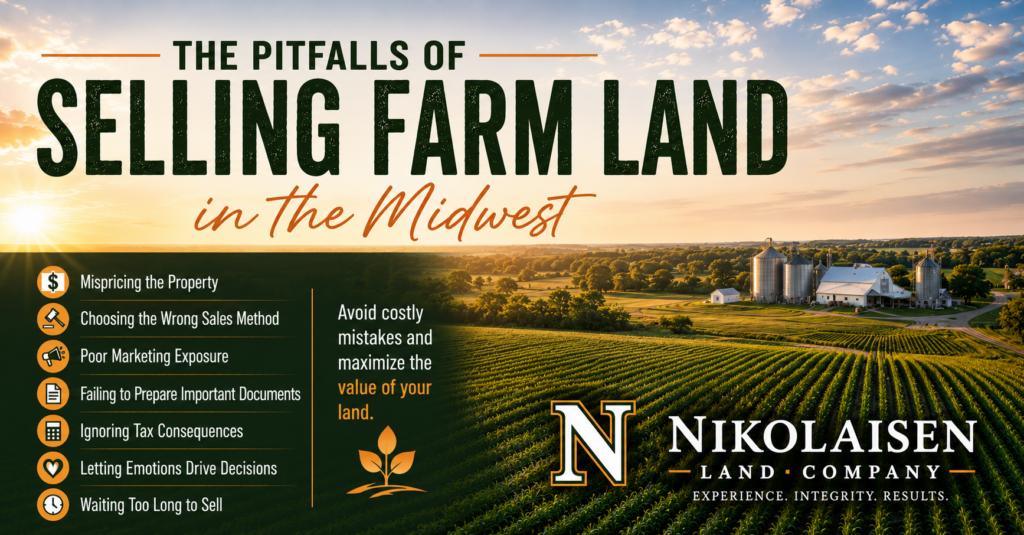
The Pitfalls of Selling Farmland in the Midwest
Selling farmland in the Midwest is often one of the largest financial decisions a landowner will ever make. Whether the land has been in the family for generations or was acquired as an investment, the process involves much more than simply putting a property on the market.
Unfortunately, many sellers unknowingly leave money on the table — or create unnecessary stress — because they underestimate the complexities involved in a farmland sale.
Here are some of the most common pitfalls Midwest landowners face when selling farmland and how to avoid them.
- Mispricing the Property
One of the biggest mistakes sellers make is relying on outdated information or generalized “per acre” values when pricing farmland.
Land values can vary significantly based on:
- Soil productivity
- Drainage quality
- Access and location
- Hunting or recreational appeal
- Crop history
- Local demand
- Farm program participation
Pricing too high can cause a property to sit on the market and lose momentum. Pricing too low can result in substantial financial loss.
A professional land valuation and market analysis is critical before listing any property.
- Choosing the Wrong Sales Method
Not every farm property should be sold the same way.
Some properties perform best through:
- Traditional listings
- Timed online auctions
- Live public auctions
- Sealed bids
- Private sales
The wrong sales strategy can limit competition and reduce final sale price. In today’s market, competitive bidding environments often create stronger outcomes for sellers — especially for highly desirable land.
Understanding local buyer demand and market timing is essential when determining the right approach.
- Poor Marketing Exposure
Farmland buyers today are not limited to local neighbors.
Investors, farmers, 1031 exchange buyers, and recreational land purchasers may come from across the region — or across the country.
A common mistake is relying on minimal advertising or generic real estate marketing that fails to reach qualified land buyers.
Effective farmland marketing should include:
- Professional aerial photography
- Drone video
- Soil and productivity data
- Detailed property information
- Online advertising
- Targeted buyer outreach
- Digital auction exposure
The more qualified buyers who see the property, the stronger the competitive interest becomes.
- Failing to Prepare Important Documents
Incomplete information can delay or derail a transaction.
Before selling farmland, landowners should gather:
- Legal descriptions
- Tax information
- FSA records
- Crop yields
- Lease agreements
- Easements
- CRP contracts
- Mineral rights information
Buyers want transparency and confidence. Organized documentation helps build trust and speeds up the sale process.
- Ignoring Tax Consequences
Farmland sales can create significant tax implications.
Without proper planning, sellers may face:
- Capital gains taxes
- Estate complications
- Income tax surprises
- 1031 exchange issues
Working with qualified tax professionals and land specialists before the sale is extremely important. A proactive strategy can often save sellers substantial money.
- Letting Emotions Drive Decisions
For many Midwest families, farmland carries deep emotional value and generations of history.
That emotional attachment is understandable — but it can sometimes complicate pricing expectations, negotiations, or family discussions.
An experienced land professional can provide objective guidance while helping families navigate difficult decisions with care and professionalism.
- Waiting Too Long to Sell
Market conditions, interest rates, commodity prices, and buyer demand all impact farmland values.
Some landowners wait too long hoping values will continue climbing indefinitely. Others rush into selling without proper preparation.
Timing matters.
Understanding current market trends and buyer behavior can help sellers make informed decisions that maximize value.
Final Thoughts
Selling farmland is not just a real estate transaction — it is often a legacy decision.
Avoiding these common pitfalls can help landowners protect their investment, reduce stress, and achieve stronger financial results.
At Nikolaisen Land Company, we understand the unique challenges of selling agricultural land throughout the Midwest. From valuation and marketing to auctions and negotiations, our goal is to help landowners navigate the process with confidence and clarity.
If you are considering selling farmland, we would be honored to visit with you about your goals and help you explore your options.
Why Choose Nikolaisen Land Company?
In today’s land market, landowners have many choices when it comes to selecting a company to help them understand, manage, market, or sell their property. At Nikolaisen Land Company, we believe the difference goes far beyond simply listing land for sale. It comes down to experience, relationships, preparation, and a genuine understanding of agriculture.
Land is more than an asset—it is often a family legacy built over generations. We understand the pride, hard work, and stewardship that come with owning farmland and ranchland throughout North Dakota, South Dakota, and Minnesota. That understanding shapes the way we approach every client and every property.
Deep Agricultural Roots
Agriculture is not just an industry to us—it is part of who we are. Our background in farming and rural communities gives us firsthand insight into the challenges and opportunities landowners face. We understand soil productivity, farming operations, land management practices, and the factors that truly influence land value.
That agricultural foundation allows us to provide thoughtful guidance backed by real-world experience.
Experience You Can Trust
Nikolaisen Land Company has successfully represented over $100 million in land and real estate transactions. Through years of working with landowners, investors, farmers, and families, we have developed a deep understanding of the land market and how to position properties effectively.
In addition to practical experience, our team has invested heavily in specialized training and continuing education related to land valuation, auctions, marketing, and real estate practices. This ongoing commitment helps ensure our clients receive knowledgeable, current, and well-informed guidance throughout the process.
Professional Marketing That Stands Apart
Every property has a story, and we believe it deserves to be presented professionally. From high-quality photography and drone imagery to detailed soil analysis, mapping, and digital marketing, we work to showcase each property in a way that reflects its true value.
Our goal is not simply to advertise land—it is to present it with the professionalism and respect it deserves.
Relationships Matter
One of the things we value most is the trust our clients place in us. Many of the landowners we work with have owned their property for decades, and often for generations. We never take that responsibility lightly.
We believe in honest conversations, clear communication, and treating people the right way. Whether someone is seeking a valuation, market insight, land management guidance, or assistance with a future sale, we strive to be a trusted resource long before and long after a transaction takes place.
A Commitment to Excellence
At Nikolaisen Land Company, we are committed to continually improving the way we serve our clients. From investing in advanced marketing tools and technology to refining the way we present and evaluate land, we believe details matter. We understand that every property represents years of hard work, stewardship, and pride of ownership. It is always an honor to work with landowners and families throughout the region, and we remain committed to providing the professionalism, integrity, and personal attention they deserve.
Our mission is simple:
To provide knowledgeable guidance, exceptional service, and a level of professionalism that reflects the quality of the land and the people we represent.
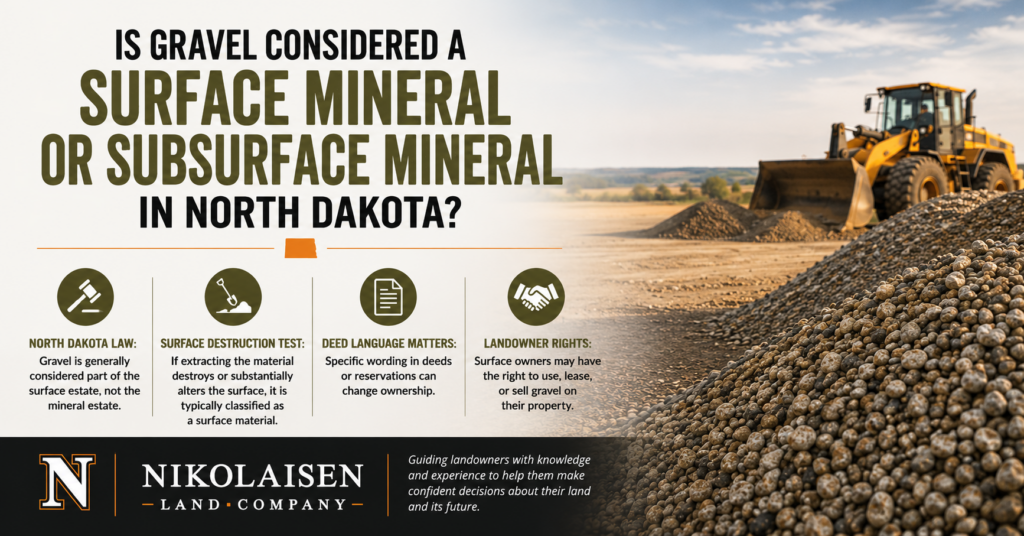
Is Gravel Considered a Surface Mineral or Subsurface Mineral in North Dakota?
One of the most common questions landowners ask in North Dakota is whether gravel belongs to the surface owner or the mineral owner. The answer matters because gravel can have significant value for road construction, oilfield development, farming operations, and commercial extraction.
In North Dakota, gravel is generally considered part of the surface estate rather than the subsurface mineral estate.
Understanding Surface Rights vs. Mineral Rights
When land ownership is divided in North Dakota, there are often two separate estates:
- Surface Estate — includes the land surface and materials necessary for ordinary surface use.
- Mineral Estate — includes oil, gas, coal, and certain valuable minerals located beneath the surface.
North Dakota law has long recognized that some substances belong to the surface owner even if mineral rights have been severed.
How North Dakota Courts View Gravel
North Dakota courts generally classify gravel as part of the surface estate because:
- gravel is usually near or at the surface,
- extraction destroys or substantially alters the surface,
- and gravel is commonly associated with ordinary land use rather than deep subsurface mining.
Unlike oil and gas, gravel cannot typically be removed without directly disturbing the land itself. Because of this, courts often consider gravel more similar to soil, sand, and clay than to traditional underground minerals.
The “Surface Destruction Test”
North Dakota follows principles similar to what many states call the “surface destruction test.”
This means courts examine whether extracting the material would:
- destroy the surface,
- substantially interfere with farming or grazing,
- or remove large portions of the land itself.
Since gravel extraction almost always requires excavation from the surface downward, it is generally treated as belonging to the surface owner unless a deed specifically states otherwise.
Why This Matters for Landowners
Gravel can become extremely valuable in:
- road projects,
- township maintenance,
- oilfield construction,
- wind energy projects,
- pipeline work,
- and commercial aggregate operations.
A landowner who owns the surface estate may have the right to:
- negotiate gravel leases,
- sell gravel,
- receive royalties,
- or deny commercial extraction.
However, ownership can become complicated if old deeds or reservations specifically mention:
- “gravel,”
- “aggregate,”
- “sand and gravel,”
- or broad mineral conveyances.
Because older deeds vary widely, title review is extremely important!
Important Exceptions
Although gravel is generally considered part of the surface estate in North Dakota, exceptions can exist when:
- a deed expressly reserves gravel,
- contracts specifically include aggregate materials,
- or prior conveyances clearly identify gravel as a mineral interest.
In those situations, the wording of the deed controls.
Oilfield and Construction Demand Has Increased Gravel Disputes
North Dakota’s oil development and infrastructure expansion have dramatically increased the value of gravel deposits. This has led to more disputes between:
- surface owners,
- mineral owners,
- township governments,
- and construction companies.
As gravel prices rise, understanding ownership rights becomes increasingly important for landowners negotiating easements, leases, or construction agreements.
Final Thoughts
In North Dakota, gravel is generally considered part of the surface estate rather than the mineral estate. However, ownership ultimately depends on:
- the language in the deed,
- prior reservations,
- and the specific facts surrounding the property.
Landowners should carefully review title documents and consult a qualified North Dakota real estate or mineral attorney before entering into any gravel agreement or extraction arrangement.
Because each property history is unique, legal advice is especially important when substantial gravel value may exist.
At Nikolaisen Land Company, we understand that questions involving surface rights, mineral ownership, and aggregate materials like gravel can significantly impact the value and future use of your property. Our team works closely with landowners, farm families, investors, and attorneys throughout North Dakota, South Dakota and Minnesota to help navigate complex land ownership issues, title questions, and real estate transactions. Whether you are evaluating gravel potential, negotiating surface use agreements, selling land, or researching ownership history, Nikolaisen Land Company is committed to providing knowledgeable guidance rooted in generations of agricultural and land experience.
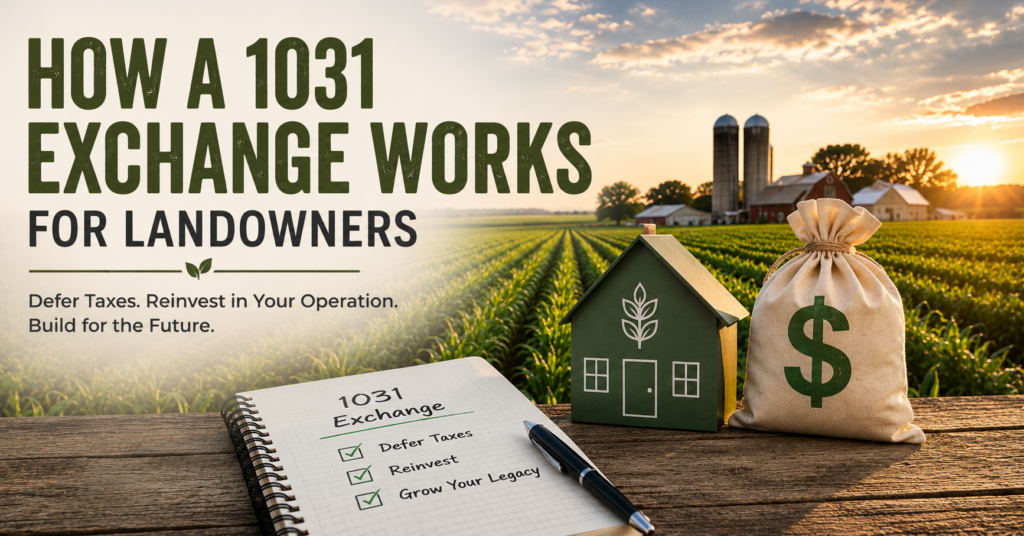
How a 1031 Exchange Works for Landowners
For many Midwest farmers and farmland owners, land is not only a long-term investment — it is also a critical part of their operation, retirement strategy, and family legacy. As land values continue to rise across the Midwest, many landowners are exploring ways to reposition assets, expand operations, consolidate acreage, or transition ownership without creating an immediate tax burden.
One of the most valuable tools available for this process is a 1031 exchange.
While the term is commonly used in real estate investing, 1031 exchanges can also provide significant advantages for farmers and farmland owners when structured correctly.
What is a 1031 Exchange?
A 1031 exchange, named after Section 1031 of the Internal Revenue Code, allows a property owner to sell investment or business-use real estate and defer capital gains taxes by reinvesting the proceeds into another qualifying property.
In simple terms, instead of paying taxes immediately after selling farmland, the seller can reinvest those funds into another property and postpone those taxes for a later date.
For farmers, this can create opportunities to:
- Expand an operation
- Purchase more productive land
- Consolidate scattered acreage
- Transition out of active farming
- Acquire income-producing property
- Improve long-term investment strategy
What Types of Property Qualify?
In agriculture, many different types of real estate may qualify for a 1031 exchange, including:
- Farmland
- Pasture ground
- Recreational land
- Commercial property
- Rental property
- Agricultural facilities
- Investment real estate
The properties involved must generally be considered “like-kind,” meaning they are both used for business or investment purposes. Fortunately, the definition of like-kind in real estate is broader than many people realize.
For example, a farmer may sell row crop acreage and purchase pasture ground, commercial property, or another investment parcel.
How the Process Works
Although every situation is unique, a typical 1031 exchange follows several important steps.
Step 1: Sell the Existing Property
The process begins when a farmer or landowner sells qualifying property. However, the seller cannot simply receive the proceeds directly if they want to defer taxes.
Instead, the funds must be held by a qualified intermediary — a third-party professional who facilitates the exchange.
Step 2: Identify Replacement Property
After the sale closes, the seller has 45 days to formally identify potential replacement properties.
This timeline is strict and one of the most important rules in the process.
Step 3: Purchase Replacement Property
The seller then has 180 days from the original closing date to complete the purchase of the replacement property.
If the deadlines are missed, the exchange may fail, and taxes could become due.
Why Farmers Use 1031 Exchanges
In the Midwest, farmland is often held for decades, meaning appreciation can be substantial. Selling ground outright may trigger:
- Capital gains taxes
- Depreciation recapture
- State tax obligations
A 1031 exchange allows landowners to defer those taxes while repositioning assets in a way that better aligns with future goals.
Common examples include:
- Trading smaller parcels for one larger tract
- Moving into higher-quality farmland
- Transitioning from active farming into rental property
- Relocating investments closer to home
- Diversifying agricultural holdings
For retiring farmers, exchanges can also create opportunities to transition away from active operations while still maintaining income-producing assets.
Timing and Planning Matter
One of the biggest misconceptions about 1031 exchanges is that they can be arranged after a property has already sold.
In reality, planning needs to begin before closing.
Because the IRS timelines are strict, landowners should assemble their professional team early, which may include:
- Attorneys
- Tax advisors
- Accountants
- Qualified intermediaries
- Agricultural real estate professionals
Proper coordination can help avoid costly mistakes and ensure the exchange stays compliant.
Challenges to Consider
While 1031 exchanges offer valuable benefits, they are not the right fit for every situation.
Potential challenges include:
- Tight identification timelines
- Difficulty locating replacement property
- Financing complications
- Rising land prices
- Complex ownership structures
- Estate and succession considerations
Additionally, tax laws can change over time, making professional guidance essential.
How Nikolaisen Land Company Can Help
A successful 1031 exchange often starts with understanding the market and identifying the right property opportunities. Nikolaisen Land Company works with farmers, investors, and landowners throughout the Midwest by assisting with farmland valuations, property marketing, land acquisitions, auctions, and identifying potential replacement properties for exchange purposes.
While legal and tax professionals should guide the technical structure of a 1031 exchange, Nikolaisen Land Company can serve as an important part of the process by helping clients navigate the agricultural real estate side of the transaction.
For many Midwest landowners, a well-planned 1031 exchange can provide flexibility, preserve investment value, and create opportunities for the next chapter of ownership.
Partnering With the Right Team Matters
Navigating a 1031 or like-kind exchange can feel overwhelming, especially when timing, property identification, and market conditions all play a critical role in the process. Nikolaisen Land Company is experienced in working alongside attorneys, accountants, qualified intermediaries, and financial professionals to help clients successfully navigate agricultural real estate exchanges throughout the Midwest. From farmland valuations and property marketing to identifying replacement properties and coordinating land transactions, Nikolaisen Land Company can be a valuable resource throughout the exchange process and help position clients for a smooth transition into their next investment opportunity.
More Than Dirt: Navigating Farm Estate & Transition Planning in the Midwest (North Dakota, South Dakota, Minnesota)
Across the Midwest, farmland is more than an asset on a balance sheet — it is legacy, identity, history, and often the foundation of an entire family’s future. Whether it’s a century farm in Minnesota, a cattle operation in the Dakotas, or a row crop enterprise in Iowa, conversations around estate and transition planning are becoming increasingly urgent as landowners age and family operations grow more complex.
Yet for many families, these discussions are delayed until a health event, financial crisis, or sudden loss forces decisions to happen quickly. By then, emotions are heightened, communication can be strained, and opportunities for thoughtful planning may already be limited.
The reality is this: transition planning is no longer optional for Midwest farm families. It is one of the most important conversations a family can have.
The Midwest is Facing a Generational Shift
A significant percentage of farmland across the Midwest is owned by individuals over the age of 65. Many of these landowners have spent decades building their operations through long hours, financial discipline, and resilience through difficult markets and unpredictable weather.
For some, the farm represents retirement security. For others, it symbolizes sacrifice and stewardship. And for nearly all, the question becomes deeply personal:
What happens to the farm when I’m no longer running it?
At the same time, younger generations are trying to determine their own future in agriculture. Some children may want to farm full-time. Others may have moved away but still feel emotionally connected to the land. Some families include multiple siblings with vastly different expectations regarding ownership, inheritance, and management.
These realities create a delicate balancing act between fairness, financial practicality, and preserving family relationships.
Why Transition Conversations Become Emotionally Charged
Estate and transition planning involves far more than taxes and legal documents. It often touches on identity, control, trust, and family dynamics that may have existed for decades.
In Midwest farm families, common emotional challenges include:
- Parents struggling to relinquish control of the operation
- Farming heirs feeling uncertain about their future
- Non-farming heirs wanting to be treated fairly
- Concerns over rising land values and cash rent income
- Fear of family conflict after a death or health event
- Anxiety about preserving the farm for future generations
These conversations can quickly become emotional because the stakes are high — both financially and personally.
For many aging landowners, the farm is not simply property. It is their life’s work.
Multi-Generation Ownership Adds Complexity
Today’s operations often involve multiple LLCs, trusts, partnerships, rented ground, machinery ownership structures, and family members participating at varying levels.
In many Midwest operations, ownership may already span two or three generations simultaneously. Grandparents may still own land, parents manage operations, and grandchildren are beginning to enter the business.
Without a clear transition strategy, this complexity can create confusion and unintended consequences, including:
- Probate complications
- Disputes between heirs
- Forced land sales
- Inefficient tax outcomes
- Fragmented ownership
- Operational instability for the next generation
Proactive planning helps families create clarity before difficult moments arise.
Transition Planning is About Communication First
One of the biggest misconceptions about estate planning is that it starts with attorneys and paperwork. In reality, it begins with honest conversations.
Families who navigate transitions successfully often prioritize:
Open Communication
Transparent conversations reduce assumptions and help align expectations among siblings and generations.
Defined Goals
Every family’s priorities are different. Some want to preserve the operation at all costs. Others prioritize equal inheritance. Some focus on retirement income and long-term care planning.
Professional Guidance
Attorneys, financial advisors, accountants, lenders, and transition specialists can help families navigate difficult topics objectively.
Gradual Transition
Many successful transitions happen over years — not overnight. Gradually transferring management responsibilities and ownership can reduce stress for everyone involved.
The Cost of Waiting
Unfortunately, many Midwest families postpone planning because the conversations feel uncomfortable. But waiting often increases the risk of conflict and financial strain.
Unexpected health issues, long-term care expenses, or sudden deaths can leave families making major decisions under emotional pressure.
Without a plan, surviving family members may face uncertainty around:
- Operating authority
- Land ownership
- Debt obligations
- Succession rights
- Tax exposure
- Business continuity
The longer planning is delayed, the fewer options families typically have.
Preserving Both the Farm and the Family
At its core, estate and transition planning is not just about transferring assets. It is about preserving relationships, honoring legacy, and creating opportunities for future generations.
For Midwest farm families, the goal is rarely just financial efficiency. It is about ensuring the farm remains productive, sustainable, and connected to the family’s values for years to come.
The best transition plans recognize both the emotional and practical realities involved. They create space for difficult conversations while providing structure and direction for the future.
Because in agriculture, legacy matters.
And the strongest plans are the ones built before a crisis forces the conversation.
Start the Conversation Before It Becomes Urgent
No two farm families are alike, and every operation carries its own history, goals, and challenges. While estate and transition planning often involves attorneys, accountants, and financial professionals, having knowledgeable agricultural real estate guidance can also play an important role in the process. Nikolaisen Land Company can assist families by providing farmland valuations, helping navigate land partition discussions, coordinating land sales or auctions, and offering insight into current Midwest land markets. Whether your family is beginning transition conversations or working through ownership decisions, Nikolaisen Land Company is available to be a trusted resource as part of your professional team.
How to Sell Land in the Upper Midwest (North Dakota, South Dakota, Minnesota)
Selling land in the Upper Midwest—whether it’s farmland, cropland, pasture, CRP acres, or hay ground—is very different from selling residential real estate.
In states like North Dakota, South Dakota, and Minnesota, land is a business asset. Buyers are focused on productivity, income potential, and long-term value, not just location.
If you’re thinking about selling land, understanding how this market works can make a significant difference in your final price.
Understanding Land Value in North Dakota, South Dakota & Minnesota
One of the most common questions sellers ask is:
“What is my land worth?”
The answer depends on more than just recent sales.
Land buyers in the Midwest evaluate:
- Soil productivity (PI, CSR, NCCPI)
- Yield history (for cropland)
- Cash rent potential
- Drainage and access
- Location relative to other farms
- Current commodity prices and interest rates
Different land types also carry different value drivers:
- Cropland: Yield, soil quality, efficiency
- Pastureland: Water access, fencing, grazing capacity
- CRP land: Annual payments, contract length, transferability
- Hay ground: Production history and accessibility
The key is positioning your land based on what buyers in your area value most.
When Is the Best Time to Sell Land in the Midwest?
Timing plays a major role in land sales.
In North Dakota, South Dakota, and Minnesota, the most active times are:
- Post-harvest (late fall): Farmers know their financial position
- Winter auction season: High visibility and competitive bidding
- Early spring: Buyers planning for the upcoming crop year
While land can sell year-round, aligning your sale with the ag cycle often leads to stronger interest and better offers.
Who Is Buying Land Right Now?
Understanding your buyer helps you market your property effectively.
Most land buyers in the Upper Midwest fall into three categories:
- Local Farmers
- Expanding existing operations
- Often willing to pay a premium for nearby land
- Investors
- Focused on stable returns and appreciation
- Looking closely at rental income and long-term value
- Recreational Buyers
- More common with pasture or mixed-use land
- Interested in hunting, privacy, and multi-use property
Each buyer type sees value differently—your marketing should reflect that.
Auction vs. Private Sale: Which Is Better?
This is one of the biggest decisions when selling land.
Land Auctions
- Create competition among buyers
- Can drive price higher in strong markets
- Work well for high-quality or highly desirable land
Private Listings
- Allow more control over price and terms
- Better for specialized properties (CRP, pasture, mixed-use)
- Provide flexibility in negotiations
The best method depends on your land, location, and current market conditions.
How to Prepare Your Land for Sale
Serious buyers expect solid information. The more prepared you are, the more confidence—and stronger offers—you’ll receive.
Before listing and while preparing to sell your land, gather:
- FSA maps and farm records
- Soil maps and productivity data
- Yield history (if available)
- Lease agreements
- CRP contracts
- Property tax details
Think of it this way:
The more your land looks like a well-documented investment, the more valuable it becomes.
Marketing Land in Today’s Market
Selling land today requires more than just putting it on the market.
Effective land marketing includes:
- Targeting local and regional farmers
- Reaching out-of-area investors
- Using high-quality aerial maps and imagery
- Highlighting income potential and return on investment
Many buyers looking for land in North Dakota, South Dakota, and Minnesota are not just local anymore—they’re searching across multiple states.
Why Local Expertise Matters When Selling Land
Land markets vary significantly—even from one county to the next.
Working with a team that understands:
- Local land values
- Active buyers
- Regional trends
- Farm programs and regulations
can make a measurable difference in your outcome. Work with a team to receive a land valuation to get an accurate understanding of your land’s value.
Final Thoughts: Selling Land Is About Positioning, Not Just Listing
Whether you’re selling cropland, pasture, CRP acres, or hay ground, the goal is the same:
Position your land as a high-value, income-producing asset
The sellers who achieve the best results typically:
- Understand their land’s true value
- Choose the right timing and sales method
- Market to the right buyers—not just the closest ones
Thinking About Selling Land in the Upper Midwest?
At Nikolaisen Land Company, we work with landowners across North Dakota, South Dakota, and Minnesota to help them understand their options and make informed decisions.
If you’re considering selling—or just want a clearer picture of what your land might be worth—we’re happy to have a conversation.Yo
No pressure, just straightforward insight based on the current market.