
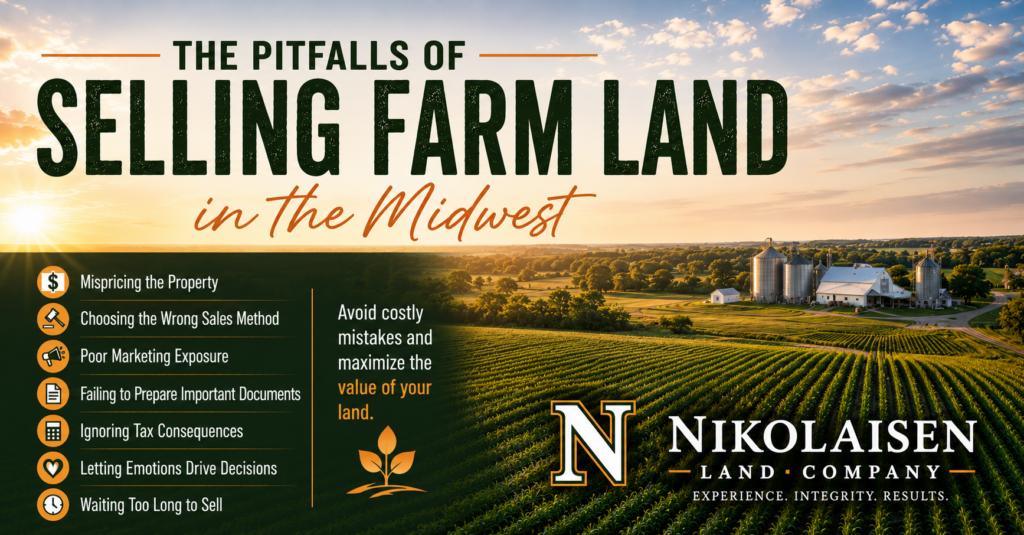
Selling farmland in the Midwest is often one of the largest financial decisions a landowner will ever make. Whether the land has been in the family for generations or was acquired as an investment, the process involves much more than simply putting a property on the market.
Unfortunately, many sellers unknowingly leave money on the table — or create unnecessary stress — because they underestimate the complexities involved in a farmland sale.
Here are some of the most common pitfalls Midwest landowners face when selling farmland and how to avoid them.
One of the biggest mistakes sellers make is relying on outdated information or generalized “per acre” values when pricing farmland.
Land values can vary significantly based on:
Pricing too high can cause a property to sit on the market and lose momentum. Pricing too low can result in substantial financial loss.
A professional land valuation and market analysis is critical before listing any property.
Not every farm property should be sold the same way.
Some properties perform best through:
The wrong sales strategy can limit competition and reduce final sale price. In today’s market, competitive bidding environments often create stronger outcomes for sellers — especially for highly desirable land.
Understanding local buyer demand and market timing is essential when determining the right approach.
Farmland buyers today are not limited to local neighbors.
Investors, farmers, 1031 exchange buyers, and recreational land purchasers may come from across the region — or across the country.
A common mistake is relying on minimal advertising or generic real estate marketing that fails to reach qualified land buyers.
Effective farmland marketing should include:
The more qualified buyers who see the property, the stronger the competitive interest becomes.
Incomplete information can delay or derail a transaction.
Before selling farmland, landowners should gather:
Buyers want transparency and confidence. Organized documentation helps build trust and speeds up the sale process.
Farmland sales can create significant tax implications.
Without proper planning, sellers may face:
Working with qualified tax professionals and land specialists before the sale is extremely important. A proactive strategy can often save sellers substantial money.
For many Midwest families, farmland carries deep emotional value and generations of history.
That emotional attachment is understandable — but it can sometimes complicate pricing expectations, negotiations, or family discussions.
An experienced land professional can provide objective guidance while helping families navigate difficult decisions with care and professionalism.
Market conditions, interest rates, commodity prices, and buyer demand all impact farmland values.
Some landowners wait too long hoping values will continue climbing indefinitely. Others rush into selling without proper preparation.
Timing matters.
Understanding current market trends and buyer behavior can help sellers make informed decisions that maximize value.
Final Thoughts
Selling farmland is not just a real estate transaction — it is often a legacy decision.
Avoiding these common pitfalls can help landowners protect their investment, reduce stress, and achieve stronger financial results.
At Nikolaisen Land Company, we understand the unique challenges of selling agricultural land throughout the Midwest. From valuation and marketing to auctions and negotiations, our goal is to help landowners navigate the process with confidence and clarity.
If you are considering selling farmland, we would be honored to visit with you about your goals and help you explore your options.